
Calculators
Australian Dietary Guidelines Macro Calculator
Work out roughly how much protein, fat and carbohydrate your body needs in a day. This macro calculator uses the Australian Dietary Guidelines, takes about two minutes, and does all the maths for you.
Treat the result as a starting point, not a rule. Your appetite, your energy and whatever’s in the fridge get a say too. On a low-spoon day, roughly enough protein is plenty.
Before you start
- Time: about 2 minutes
- You’ll need: your age, height in centimetres, weight in kilograms, and a rough idea of how much you move in a normal week
- Maths: none. The calculator does all of it
- You’ll get: an estimate of your daily energy needs, plus grams of fat, protein and carbs
Step by step
How to use the macro calculator
1
Basic information: enter your sex, age, height and weight.
2
Activity level: pick the one that matches a typical week, not your best one. If your capacity swings a lot, start with the level that matches most weeks.
3
Goal: choose Maintain unless your GP or dietitian has given you a different target.
Your daily targets
0 calories a day about 0 kJ
- Basal metabolic rate (BMR)
- 0 calories a day
- Body mass index (BMI)
- 0
A starting point, not a rule. If these numbers don’t suit you after a couple of weeks, change them.
Your numbers
What your results mean
Basal Metabolic Rate (BMR)
The energy your body uses at complete rest, just keeping you breathing, warm and ticking over. It’s the floor, not the target.
Body Mass Index (BMI)
A rough population screening number worked out from height and weight. It doesn’t know your muscle, your frame or your health, so don’t read much into it.
Target energy per day
Your BMR adjusted for activity. The calculator shows this in Calories, with kilojoules underneath. Australian food labels use kilojoules, so multiply by 4.2 to compare (2,000 Cal is about 8,400 kJ).
Macronutrient balance
Your daily energy split into grams of fat, protein and carbohydrate. On the Maintain goal the split is 40% carbohydrate, 30% protein and 30% fat. Other goals shift it, and each goal shows its split in the calculator.
All of these are estimates from equations based on population averages, so they can be off for any one person. If the numbers feel wrong for your body, your body is the better guide.
The guidelines
What are the Australian Dietary Guidelines?
The Australian Dietary Guidelines are the National Health and Medical Research Council’s (NHMRC) advice on what to eat for general health. They’re the baseline most GPs and dietitians in Australia work from, which makes them a useful shared starting point, even if your own eating looks different.
Which version
The current guidelines were published in 2013. NHMRC is reviewing them, and until the new version is released, the 2013 guidelines still apply.
Who they’re for
Healthy adults and children, including people with common diet-related risk factors. They’re not designed for people who need specialised dietary advice for a medical condition, so treat them as a reference point rather than a prescription.
The short version
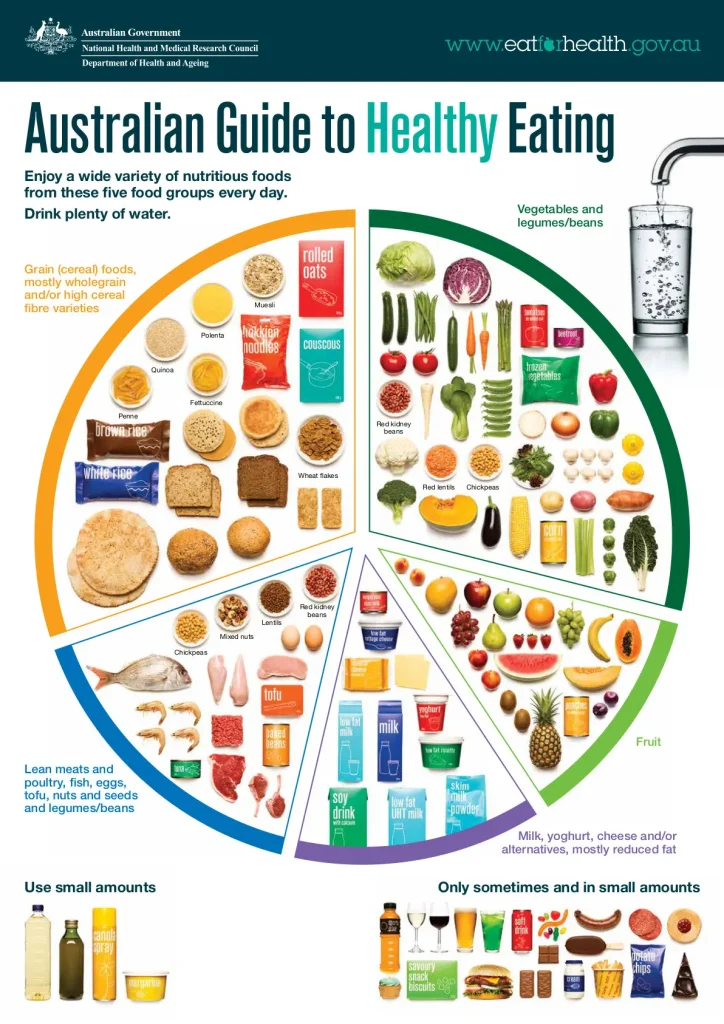
Eat a wide variety of foods from the five food groups every day, drink plenty of water, and keep discretionary foods (the ones outside the five groups) to sometimes and in small amounts.
The five food groups are:
- Vegetables and legumes or beans
- Fruit
- Grain (cereal) foods, mostly wholegrain or high fibre
- Lean meats and poultry, fish, eggs, tofu, nuts and seeds, and legumes or beans
- Milk, yoghurt, cheese and their alternatives
The full guidelines and serve sizes live at Eat for Health.
Guidelines in practice
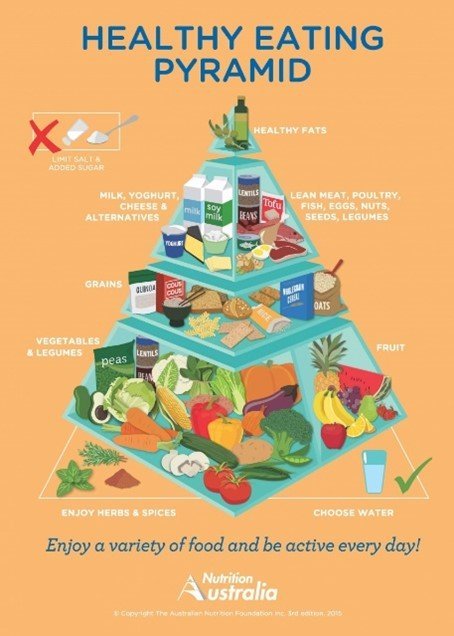
The Healthy Eating Pyramid
Nutrition Australia turned the guidelines into the Healthy Eating Pyramid. The bigger the layer, the more of your plate it’s meant to fill. Vegetables, legumes and fruit sit at the bottom, then grains, then the protein and dairy foods, with healthy fats as a small top layer.
Got your numbers?
Turning your numbers into meals
You don’t need to plan every gram. A few low-spoon ways to get closer to your protein number without much cooking:
- Supermarket roast chook: pull it apart once and it covers lunches for days.
- Eggs: boiled in a batch, or microwaved in a mug in about a minute.
- Greek yoghurt: straight from the tub with whatever fruit is open.
- Tinned lentils, chickpeas or beans: rinse and add to soup, salad or a wrap.
- Cheese and crackers: it counts. Truly.
Every No Spoons recipe lists its macros, so you can find recipes that fit without redoing the maths. They’re estimates, worked out in Carb Manager from the brands we tested with, and here’s how we work them out. New to macros? Start with Macros made simple: the quick-start guide, then how macros fuel our body.
Find recipes that fit →Frequently asked questions
Is the macro calculator accurate?
It’s a good starting estimate, not a measurement. The equations are based on population averages, so your real needs could be higher or lower. Use it as a ballpark and adjust from how you feel.
Calories or kilojoules?
The calculator shows Calories, with kilojoules underneath. Australian food labels use kilojoules. Multiply Calories by 4.2 to get kilojoules.
Do I have to hit these numbers every day?
No. Over a week is a more useful way to look at it. On a no-spoons day, eating something at all counts.
Can I use it if I have a health condition?
You can use it as a reference point, but the guidelines aren’t designed for people who need specialised dietary advice. A GP or Accredited Practising Dietitian can tailor the numbers to you.
Why base it on the guidelines when No Spoons has keto recipes?
Because they’re the shared starting point most Australian health professionals use. The calculator’s balance has more carbohydrate than keto or low carb eating, so if that’s how you eat, Keto vs low carb: what’s the difference? explains how the numbers change.
Is it suitable during pregnancy, breastfeeding or for children?
No. Energy and nutrient needs are different for those groups. Talk to your GP, midwife or child health nurse instead.
