
Short answer: some foods and eating patterns have decent human evidence for blood-vessel function in general, and nobody has tested them in CRPS. A friend is giving a keynote on circulation and CRPS in a few weeks, and she asked me a cracking question: what easy things can we do with food to support our circulation? This page covers what the research measured, what it can’t tell us, and small changes that suit low-spoon days, shortcuts included, plus a few things I’ve tested on my super (un)controlled study of one.
How I label the evidence
Each finding carries one tag: Clinical evidence (stronger, or limited or mixed), Emerging, Clinician opinion or Traditional use. Unless I say otherwise, the research is in people without CRPS, and a marker like blood pressure isn’t a symptom. The food research is a stand-in for blood flow in a CRPS limb, and I’ll say so every time.
What do we mean by circulation?
CRPS can involve inflammation, altered pain processing and disturbances in the nerves that control blood vessels and sweating. Temperature and skin colour changes are recognised features, but they vary from person to person, and a cold or discoloured limb doesn’t by itself point to a food remedy. [1]
Evidence Emerging (one study, chronic CRPS): the temperature difference between the affected and unaffected leg disappeared overnight, so one reading never tells the whole story. [2]
Food studies usually measure something else:
- Flow-mediated dilation (FMD): how well an artery widens when blood flow increases.
- Blood pressure.
- Blood markers, such as C-reactive protein (CRP).
None of those is blood flow in an affected limb, and none is pain. A better FMD doesn’t mean less CRPS pain. For comparison, the treatments with evidence for Raynaud’s phenomenon, another blood-vessel overreaction, are medicines, and the review’s abstract lists no dietary interventions. [3]
What the research shows
None of these were tested in CRPS.
| Food or pattern | What was measured | What studies found | Evidence label |
|---|---|---|---|
| Mediterranean-style pattern | FMD | 14 trials, 1,930 adults: FMD about 1.7 percentage points higher. [4] | Clinical evidence, stronger (blood-vessel function in general) |
| Dietary nitrate (beetroot, leafy greens) | FMD, blood pressure | 13 trials: FMD about 1.5 points higher on average, with very high variation. [5] | Clinical evidence, limited or mixed |
| Cocoa flavanols | Blood pressure | Cochrane review, 35 trials, 1,804 mostly healthy adults: about 2 mmHg lower. [6] | Clinical evidence, limited or mixed (small effect) |
| Omega-3 fats (EPA and DHA supplements) | FMD | 32 studies, 2,385 people: about 0.8 points higher, with high variation. [7] | Clinical evidence, limited or mixed |
How to read it: a change of a point or two in a blood-vessel test is a small shift. It’s a good sign about the pattern in general, and it isn’t a promise about your hands or feet. I’d treat the table as “reasons to eat these foods if you enjoy them”, not “treatments”.
Beetroot and leafy greens
Dietary nitrate can be converted into nitric oxide, which helps blood vessels relax.
Evidence Clinical evidence, limited or mixed (68 people with high blood pressure): four weeks of nitrate-rich beetroot juice improved blood pressure and blood-vessel function compared with nitrate-depleted juice. [8]
Across trials, results varied a lot, and single doses showed bigger effects than longer-term eating. [5]
I’ve added some tasty recipe ideas to try at the end of the article.
Check first: if you have low blood pressure, get dizzy, or take blood-pressure medicines, ask your GP or pharmacist before using concentrated beetroot shots or powders. A salad is a different thing.
Cocoa
The Cochrane review found cocoa flavanols lowered blood pressure by about 2 mmHg, which is a small effect.
Evidence Clinical evidence, limited or mixed (35 trials, 1,804 mostly healthy adults): the trials were short (mostly 2 to 12 weeks), several were company-funded, and none measured heart attacks or strokes. [6]
Unsweetened cocoa stirred through yoghurt is an easy one. Check the label for sugar and fat, because the studies don’t tell us what a chocolate bar does. Sadly, I wouldn’t read this as a reason to eat more chocolate.
Omega-3 without the seafood
The omega-3 trials measured EPA and DHA, mostly from supplements.
Evidence Clinical evidence, limited or mixed (32 studies, 2,385 people): blood-vessel function (FMD) was about 0.8 points higher, with high variation, and the abstract doesn’t mention plant omega-3. [7]
Ground linseed, chia seeds and walnuts provide alpha-linolenic acid (ALA), a plant omega-3. The body converts only small amounts into EPA and DHA, so they’re useful but not nutritionally identical. [9] I couldn’t find circulation research on the plant version.
What’s been looked at in CRPS
CRPS-specific evidence is thin.
Evidence Emerging (observational, 20 people with CRPS and 15 controls): a small study compared fatty-acid levels between the two groups. [10]
The other CRPS-specific work is in mice.
Evidence Emerging (animal, one mouse study): the study reported benefits from preventive omega-3. [11]
Neither is a human treatment, or a reason to ban seed oils.
If you have a seafood allergy, stick to tolerated plant foods and skip fish or krill oils. I have a seafood allergy myself.
If an EPA/DHA supplement is being considered for an identified need, ask your pharmacist or allergy clinician about an algae-derived product, its ingredients and manufacturing cross-contact. Algae-derived doesn’t automatically mean suitable for every allergy.
Warming spices and Ayurveda
There are many online trends talking about the virtues of whole foods, traditional cooking and using food as medicine.
I think there’s a lot of merit in whole foods and more traditional ways of eating. The Blue Zones research is often cited in support, which I touch on a little more below, in the Mediterranean-style section. These ideas also get traced back to Ayurveda, sometimes called “Vedic medicine”. Concepts like agni (digestive fire) and the six tastes are a traditional framework, not validated tests of circulation or CRPS. [12]
Spices are central to many traditional foods and to Indian cooking and home remedies. Ginger or chilli can feel warming, but that sensation isn’t proof of better blood supply.
Traditional use: the spice rack in these kitchens is much bigger, and includes turmeric (haldi), ginger (adrak), cumin (jeera), coriander (dhania), fennel (saunf), cardamom (elaichi), black pepper, cinnamon, fenugreek (methi), asafoetida (hing) and carom seeds (ajwain).
We use a lot of them in our No Spoons recipes because they taste good. And they’ve traditionally been used for digestion and gut comfort. Here’s what the human research shows, in short:
Ginger
The ginger trials used supplements, not the frozen ginger in your freezer.
Evidence Clinical evidence, limited or mixed (nine randomised trials, ginger supplements): CRP, a blood marker of inflammation, was about 0.84 mg/L lower on average. It isn’t a pain score, and I only read the summary page. [13]
Turmeric
Cooking with turmeric is fine.
Evidence Clinical evidence, limited or mixed (97 people with diabetic neuropathy, nanocurcumin): a 2025 trial found no pain or neuropathy benefit. [14]
The TGA warns turmeric medicines can rarely cause serious liver injury. [15] I couldn’t open the reviews on curcumin and inflammation markers, so I’m not quoting them.
Cumin and fennel
Cumin and fennel come up for gut comfort, mostly in concentrated products.
Evidence Emerging (small IBS trials, concentrated products): symptoms eased in small trials, which I read about in a secondary summary. [16]
The rest
Coriander, cardamom, black pepper, cinnamon, fenugreek, hing and ajwain: I haven’t researched them for this article, so they stay under traditional use.
My take: enjoy them as flavour, and don’t treat any of them as a stand-alone circulation or gut treatment. Garam masala, curry paste, frozen ginger and ground cumin all count. Go mild if heat triggers reflux, and ask your pharmacist before taking any concentrated spice supplements. Be wary of imported Ayurvedic medicines too, because some contain or are contaminated with lead, mercury or arsenic. That’s about medicines, not a reason to avoid Indian food. [12]
Two nutrients to check first
These aren’t circulation foods. They’re the two where a deficiency or an excess can cause nerve symptoms that get blamed on CRPS.
- Vitamin B12: deficiency can cause numbness and tingling, even without anaemia. Treating a genuine deficiency matters. Extra B12 when your levels are adequate hasn’t been shown to help CRPS directly. [17] Ask your GP or an Accredited Practising Dietitian whether a check is worth it.
- Vitamin B6: supplements can themselves cause peripheral neuropathy. It turns up in multivitamins and in magnesium or zinc products, and several can add up. The TGA says no minimum risk-free dose has been established. B6 naturally present in food isn’t linked to this. [18] Bring the labels of everything you take to a pharmacist, and don’t automatically blame new burning, tingling or numbness on CRPS.
Two foundations: Mediterranean-style and keto
Most of the foods above sit on top of an eating pattern. I lean on two: a Mediterranean-style pattern, and keto or lower-carb. Their evidence is different, so I’ve kept them side by side.
The Mediterranean-style pattern
This is the best-studied option for blood-vessel function in general. That means vegetables, fruit, legumes, wholegrains, olive oil, nuts or seeds where you tolerate them, and enough protein. Eggs, yoghurt, tofu, poultry or meat can all be part of it. It doesn’t need seafood, expensive ingredients or cooking everything from scratch. [4]
Evidence Clinical evidence, limited or mixed (164 adults at high heart risk, PREDIMED substudy): several markers of vascular inflammation changed after a year of Mediterranean-style eating. A marker isn’t a symptom. [19]
The Blue Zones often get cited as support for this pattern.
Evidence Emerging (observational): the Blue Zones, regions reported for unusually long lives, include Ikaria in Greece and Ogliastra in Sardinia, and a largely plant-based way of eating is one of the habits often credited. The longevity records have been disputed, and some of these regions are now losing their advantage, which is speculated to align with more processed foods in daily diets. [20]
Olive oil suits dressings and cold meals, and avocado oil handles cooking heat. Use whichever you can afford and enjoy.
Where keto fits
I started eating keto and lower-carb to lose weight. I kept going because I noticed positive changes in my pain levels and energy. Those changes became part of my reason for continuing.
I think this is because of a combination of factors. I eat more nutrient-dense meals, with more attention to protein, fats and the other nutrients I’m getting. I’ve also cut back on processed foods with additives, although I wasn’t eating a huge amount of them to begin with.
There is early research that makes keto worth investigating as part of pain management, which interests me because it sits next to what I’ve noticed in my own life. The human studies are small, though, and they don’t establish keto as a treatment for CRPS. [21, 22]
Evidence Emerging (small pilot, 24 people with chronic musculoskeletal pain, not CRPS): 15 ate ketogenic and 9 ate a whole-food comparison, and pain was lower in both groups over 12 weeks. [21]
A second pilot is smaller again.
Evidence Emerging (small pilot, 7 adults with limb loss, not CRPS): a six-week low-carb diet reported improvements, with no control group. [22]
I couldn’t find a controlled trial of keto in established CRPS, or a validated carb target or duration. This is the approach I’ve chosen. It isn’t a rule for how anyone else with CRPS needs to eat.
What I found on keto and blood vessels
The blood-vessel data on keto comes from children and young people on a medical diet for epilepsy.
Evidence Emerging (observational, 43 children and young people with epilepsy): 23 had been on a ketogenic diet for at least six months and 20 never had. Those on the diet had stiffer arteries and higher cholesterol or triglycerides, before any thickening of the artery wall showed up. [23]
That’s a different group, a medical diet and a different purpose, so it doesn’t tell us what happens in an adult with CRPS eating lower-carb.
My read: keto is a reasonable research question and a possible supervised experiment. It isn’t an established CRPS treatment, and I don’t see enough evidence to say it beats a less restrictive approach for CRPS pain or circulation.
Cholesterol on keto, in brief (because I know someone is going to ask)
LDL cholesterol matters for circulation because it’s tied to plaque in artery walls. Here’s the short version. None of it is CRPS research.
The established position hasn’t changed. The European Atherosclerosis Society’s 2017 consensus statement concluded that LDL causes atherosclerotic cardiovascular disease. [32]
What trials and guidelines found
Evidence Clinical evidence, limited or mixed (13 trials, 1,577 adults): LDL rose slightly more on very low carb ketogenic diets than on low-fat ones (about 0.12 mmol/L over 12 months or more), while HDL rose and triglycerides fell. It measured risk factors, not heart attacks or strokes. [24]
The National Lipid Association’s 2019 statement calls the LDL effects mixed and long-term data thin. [25]
Evidence Clinical evidence, limited or mixed (17 healthy young women, four-week feeding trial): a saturated-fat-rich ketogenic diet raised LDL and apoB. [26]
What researchers propose, not shown
Some lean people on keto have very high LDL with high HDL and low triglycerides.
Evidence Emerging (observational, 80 lean people on keto for about 4.7 years and 80 matched controls): average LDL was 272 mg/dL, and coronary plaque and calcium scores weren’t significantly different from the controls. It’s a small snapshot of a selected group (high HDL, low triglycerides, mostly White), the Citizen Science Foundation funded it, and it didn’t track heart attacks or strokes. It can’t show that high LDL is harmless. [27]
A 2026 viewpoint calls “lower risk in lean hyper-responders” a hypothesis, not a finding, and suggests measuring apoB and lipoprotein(a), and considering a calcium scan, with a clinician. [28]
What’s missing
No CRPS data, no long-term event data for diet-raised LDL, and I couldn’t find an Australian position statement. European guidance classes LDL of 190 mg/dL or higher as a very high single risk factor, which puts a person in the high-risk group. I read a summary of the guideline, not the guideline itself. [31]
Your lipid results are personal. Talk them through with your GP or a cardiologist, and don’t change or stop any medicine on the strength of anything here. When I eat lower-carb, I tend to lean on olive oil, avocado, nuts and seeds, non-starchy vegetables and enough protein, and I go lighter on butter, cream and coconut oil. That’s my reasoning from the feeding trial, not a rule, and it’s worth talking through with your GP or dietitian.
Before you try keto
Adult ketogenic-therapy guidelines list constipation, stomach symptoms and raised blood lipids among possible side effects, though they’re mostly about epilepsy. [29] Check with your GP or dietitian before starting if you have diabetes, take glucose-lowering medicines, are pregnant or breastfeeding, have an eating-disorder history, struggle to eat enough, or have significant organ disease. If you take an SGLT2 inhibitor (empagliflozin, dapagliflozin and similar), talk to your prescriber before going anywhere near keto, because low carbohydrate intake can raise the risk of ketoacidosis, sometimes without very high blood glucose. [30] Dizziness, worsening fatigue, nausea or trouble eating are reasons to get a review, not something to push through.
Recipes on No Spoons that fit
These are existing recipes, so I’ve gone by what each page lists, and carbs are as printed there.
- Beetroot Egg Muffins (Low Spoons, 20 minutes, makes 12). Eggs, Greek yoghurt, cheese and bagged beetroot slaw. Listed at 2 g carbs per muffin and tagged freezer friendly. Each muffin only has a little beetroot, so it’s a pleasant way to eat it, not a nitrate dose.
- Green Shakshuka (Low Spoons, 35 minutes, serves 2). Baby spinach, parsley, cumin, avocado oil and eggs. The page lists 27 g carbs per serve even though it’s tagged low carb, so check that against your own target.
- Ricotta Rainbow Bake (No Spoons Day, 40 minutes, serves 4). Frozen cauliflower and chard or spinach under a ricotta sauce. Listed at 5 g carbs per serve and freezer friendly. The sauce uses a bone broth mayo, so it isn’t vegetarian unless you swap it.
- Kotopoulos Skorthato Tray Bake (No Spoons Day, 35 minutes, serves 2). Lemon and garlic chicken with kale, broccolini and olive oil on one tray. The closest match to the Mediterranean-style pattern. The carb figure on the page is unclear, so check the label if you’re counting.
- Bobotie (More Spoons, serves 4). Curried mince with turmeric, cumin, coriander, cinnamon and black pepper, tagged batch cook and freezer friendly. It’s built on ghee and coconut cream, so if you’re watching your lipids, ask your GP or dietitian how it fits your results.
There’s no recipe on the site yet that leans on cocoa or ground linseed, so the cocoa yoghurt pot below is just an idea for now.
Three ideas to build on
These are ideas, not tested recipes.
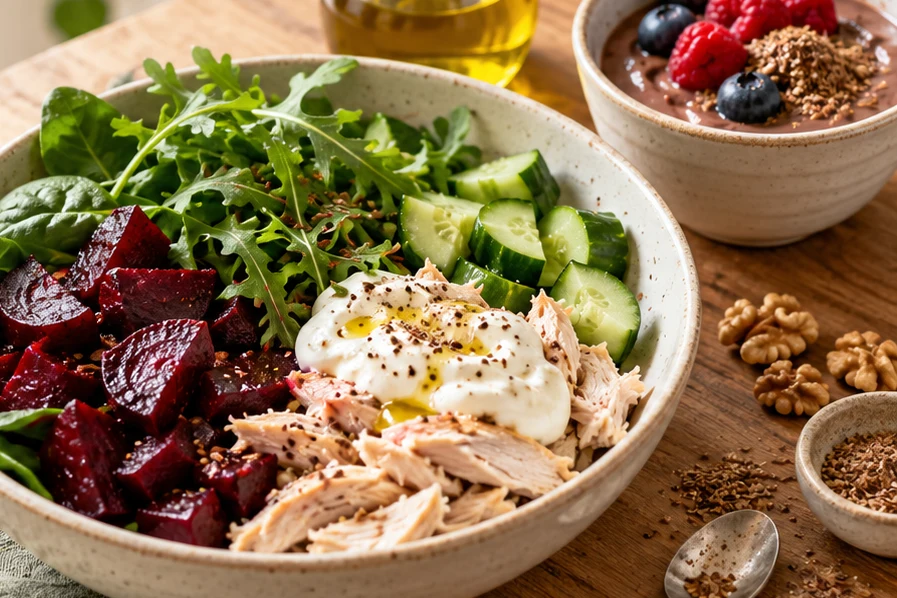
- Beetroot, rocket and yoghurt bowl. Ready-cooked beetroot, bagged rocket and plain yoghurt, with lemon and olive oil. Add drained chickpeas if you’re going Mediterranean-style. Lower-carb: skip the chickpeas, add tofu or cooked chicken and cucumber.
- Lentil-and-spinach bowl. Ready-made dhal, microwave rice and frozen spinach, cooked to packet directions. Pick a mild dhal if chilli or reflux is a problem. Lower-carb: dhal can fit lower-carb macros in a smaller serve, but lentils are a legume, so it isn’t strictly keto. Swap the rice for microwave cauliflower rice, add tofu, and check the dhal’s carbs on the label against your own target.
- Cocoa yoghurt pot. Plain yoghurt with a spoonful of unsweetened cocoa, a few berries and ground linseed. It’s assembly only. Check the yoghurt’s carbs if you’re going lower-carb.
On a no-spoons day, any of these can shrink to its smallest honest version: dhal and rice from the pouch, yoghurt and fruit, or beetroot straight from the packet on toast.
If you decide to try any of this
Pick one change that solves a real problem, and keep breakfast within reach.
Agree on a review period with your dietitian and GP if you’re making a bigger change like keto. There’s no proven trial duration for CRPS.
If tracking helps, jot down appetite, gut comfort, meal effort and how you’re managing everyday tasks. Pain should go on the list, but one good or bad day can’t prove a food effect.
An eating plan that keeps leaving you hungry, overwhelmed or unable to prepare food needs adjusting. It should fit your life as it is now.
A final spoon-saving note
Save this one for a day your brain has spare room. If you take only one thing away, make it this: pick one food you enjoy, make it manageable, and call it done. The research will still be here when you want more.
Sources
Numbers match the citations above. Research checked 14 October 2026.
- Harden and colleagues. Complex Regional Pain Syndrome: Practical Diagnostic and Treatment Guidelines, 5th Edition (2022).
- Schilder and colleagues. Diurnal and nocturnal skin temperature regulation in chronic complex regional pain syndrome. The Journal of Pain (2014). Abstract read. PubMed · DOI
- Huisstede and colleagues. Effectiveness of interventions for secondary Raynaud's phenomenon: a systematic review. Archives of Physical Medicine and Rehabilitation (2011). Abstract level. PubMed · DOI
- Shannon and colleagues. Mediterranean diet increases endothelial function in adults: a systematic review and meta-analysis of randomized controlled trials. Journal of Nutrition (2020). Abstract level. PubMed · DOI
- Celik and colleagues. The impact of inorganic nitrate on endothelial function: a systematic review of randomized controlled trials and meta-analysis. Nutrition Reviews (2026). Abstract level. PubMed · DOI
- Ried and colleagues. Effect of cocoa on blood pressure. Cochrane Database of Systematic Reviews (2017, CD008893.pub3). PubMed · DOI
- Arabi and colleagues. Omega-3 fatty acids and endothelial function: a GRADE-assessed systematic review and meta-analysis. European Journal of Clinical Investigation (2023). Abstract level. PubMed · DOI
- Kapil and colleagues. Dietary nitrate provides sustained blood pressure lowering in hypertensive patients: a randomized, phase 2, double-blind, placebo-controlled study (2015). PubMed
- NIH Office of Dietary Supplements. Omega-3 fatty acids fact sheet. Consumer version.
- Do omega-6 and trans fatty acids play a role in complex regional pain syndrome? A pilot study (2010). PubMed
- Preventive supplementation of omega-3 reduces pain and pro-inflammatory cytokines in a mouse model of complex regional pain syndrome type I (2022). PubMed
- NCCIH. Ayurvedic medicine: in depth.
- Mazidi and colleagues. The effect of ginger supplementation on serum C-reactive protein, lipid profile and glycaemia: a systematic review and meta-analysis. Food & Nutrition Research (2016). Summary page only. PubMed · DOI
- Mansour and colleagues. Nanocurcumin supplementation for diabetic peripheral neuropathy in patients with type 2 diabetes: a randomized double-blind clinical trial (2025). PubMed
- Therapeutic Goods Administration. Medicines containing turmeric or curcumin: risk of liver injury (2023).
- ScienceAlert. 5 common herbs and spices with digestive benefits backed by science. Secondary summary; primary trials not read. (No link.)
- NIH Office of Dietary Supplements. Vitamin B12 fact sheet. Consumer version.
- Therapeutic Goods Administration. Peripheral neuropathy with supplementary vitamin B6 (pyridoxine) (updated February 2026).
- The effects of the Mediterranean diet on biomarkers of vascular wall inflammation and plaque vulnerability in subjects with high risk for cardiovascular disease: a randomized trial (2014). PubMed
- Brincat C. Do people in blue zones actually live longer? Popular Science (24 March 2025). Secondary summary; primary studies not read. (No link.)
- Effects of a low-carbohydrate ketogenic diet on reported pain, blood biomarkers and quality of life in patients with chronic pain: a pilot randomized clinical trial (online 2021). PubMed
- Wiggins and colleagues. Investigation of the impact of a low-carbohydrate diet on the chronic pain experience among adults with an acquired limb loss: a pilot study (2025). PubMed
- Coppola and colleagues. The impact of the ketogenic diet on arterial morphology and endothelial function in children and young adults with epilepsy: a case-control study. Seizure (2013). Abstract level. PubMed · DOI
- Bueno and colleagues. Very-low-carbohydrate ketogenic diet v. low-fat diet for long-term weight loss: a meta-analysis of randomised controlled trials. British Journal of Nutrition (2013). PubMed · DOI
- Kirkpatrick and colleagues. Review of current evidence and clinical recommendations on the effects of low-carbohydrate and very-low-carbohydrate (including ketogenic) diets: a scientific statement from the National Lipid Association (2019). PubMed · DOI
- Burén and colleagues. A ketogenic low-carbohydrate high-fat diet increases LDL cholesterol in healthy, young, normal-weight women: a randomized controlled feeding trial (2021).
- Carbohydrate restriction-induced elevations in LDL-cholesterol and atherosclerosis: the KETO trial. JACC Advances (2024).
- Özlek. Reassessing LDL-cholesterol elevations in lean-mass hyper-responders: clinical significance and unresolved questions. European Journal of Preventive Cardiology (2026).
- International recommendations for the management of adults treated with ketogenic diet therapies (2021).
- Therapeutic Goods Administration. Sodium glucose co-transporter 2 inhibitors. Safety advisory.
- The Task Force for the Management of Dyslipidaemias of the ESC and EAS. 2019 ESC/EAS Guidelines for the Management of Dyslipidaemias: Lipid Modification to Reduce Cardiovascular Risk. European Heart Journal (2019). I read the American College of Cardiology's summary page only, not the guideline. ACC summary
- Ference and colleagues. Low-density lipoproteins cause atherosclerotic cardiovascular disease. 1. Evidence from genetic, epidemiologic, and clinical studies. A consensus statement from the European Atherosclerosis Society Consensus Panel. European Heart Journal (2017). Publication listing and abstract-level conclusion only. DOI


