Pain doesn’t only hurt. It changes what you want to eat, and for a lot of us, pain and sugar cravings arrive together. I went looking for the reason, and what I found is interesting rather than settled.
This guide covers what stress hormones might be doing, what low carb has done for me, and the small swaps that make cutting back easier on a low-spoon day. Start with one change. That’s plenty.
What stress hormones might be doing
When you’re in pain, your body treats it as a threat. Stress hormones like cortisol and adrenaline rise, and part of their job is to get quick fuel into your bloodstream. That fuel is glucose, because it’s the fastest energy source on offer. Your body’s logic is basically: “I need energy to run from the dinosaur.”
It’s easy to turn this into a loop: pain nudges you towards sugar, and sugar makes pain worse. The first half has a plausible mechanism. The second half is less certain, and I’ll get to it below. Stress and cravings have been studied together. Research on chronic pain specifically is thinner.
Do we actually need sugar?
Short answer: no. Your body needs glucose, but it can make what it needs. When carbs are low, it builds glucose from amino acids (from protein) and glycerol (from fat). It can also shift to burning fat for energy, and your liver turns some of that fat into ketones, which your brain and muscles can use as fuel. That shift is ketosis. If you want the macros side, How macros fuel our body goes through it.
I feel my best in ketosis. My energy is better, my pain is dramatically reduced, my allodynia is quieter and I don’t get the same radical flares when the weather changes. That’s my experience in my body, not a promise. The research on ketogenic eating and pain is early and mostly small, so I treat it as promising rather than proven, and it won’t suit everyone. I’ve written more in Why keto helps with pain management.
Does sugar fuel pain?
Sugar gets blamed for inflammation, and inflammation can sit behind pain flares. These are the mechanisms that usually get cited. Let me get a lil nerdy for a minute, and I’ll say how much weight I’d put on each.
- Insulin resistance. Eating a lot of refined carbs over time can contribute to insulin resistance, and insulin resistance is associated with higher inflammation markers like C-reactive protein (CRP). That link is reasonably well supported in general. Whether it changes pain in people with CRPS is a different question.
- AGEs. When sugar attaches to proteins or fats without insulin involved, it forms advanced glycation end products (AGEs). Lab research shows AGEs can switch on inflammatory pathways. Much of that research comes from diabetes studies, so I treat it as a plausible mechanism, not proof.
- The NLRP3 inflammasome. This is a group of proteins that helps start inflammatory responses. Some studies, many of them in cells or animals, link high fructose intake to switching it on. Interesting, and early.
- Gut bacteria. Sugar-heavy eating can change the mix of bacteria in your gut, and researchers are looking at whether that affects inflammation. It’s an active area, not a settled one. Sweeteners are the same: the research is mixed and nobody can give you a tidy answer yet. Keto sweeteners are generally easier on blood sugar, but there’s a lot still unknown, so I keep anything sweetened as an occasional thing. More on the gut side in The Gut-Brain Axis.
- Uric acid. Your liver’s handling of fructose can raise uric acid, and high uric acid is linked to gout. That link is well established. As far as I know, it hasn’t been tested for CRPS pain.
Put together, these are plausible, not proven. What I can’t tell you is how much sugar matters for your pain compared with sleep, stress, medication, movement and everything else going on. What I can tell you is that when I cut it back, I feel better.
Pain and sugar cravings: the chicken or the egg
Honestly, I don’t know which comes first, and I’m not sure anyone does. Pain can make eating feel optional. Sugar is quick and easy when you’re flat. When I’m not eating enough, or not eating enough of the right things, pain gets louder and I have less capacity to do anything about it. Pain becomes the tail wagging the dog.
I do believe eating matters on pain days. I also know it’s easier said than done. On days when pain has turned my appetite off, I have bone broth or a protein shake at least. I keep protein snacks around, like little meatballs or protein muffins. Something is better than nothing, and I know many of us end up with nothing. Protein in store-bought broth varies a lot by brand, so check the label if protein is the point. If appetite is your bigger problem, Chasing pain: why eating matters is the one to read.
Where to start
Cutting back on sugar is a deliberate decision. It’s in a lot of packaged food, so avoiding it takes some label reading. When you’re already flat, that’s a big ask. Hard isn’t impossible, though, and you don’t have to do it all at once. Small tweaks are easier to keep.
Pick one change
Maybe for you that looks like:
- Swapping to a low carb bread or pasta.
- Having bone broth daily, as a savoury, easy-to-sip option.
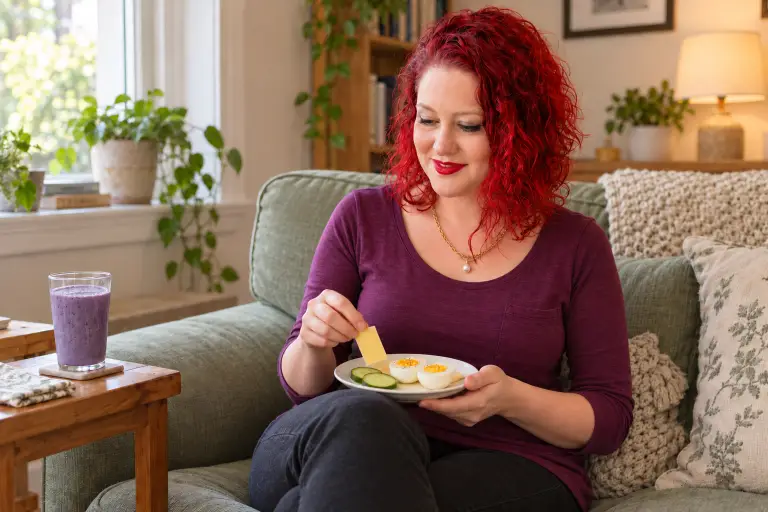
- Making an effort to eat breakfast, even if it’s a smoothie.
- Choosing a higher protein, lower sugar yoghurt.
- Swapping the sugar in your tea for monkfruit.
- Swapping wheat crackers for a lower-carb cracker. Check the label.
Eating enough, and eating things that suit you, is a challenge for a well person, let alone someone living with chronic pain. If one swap is all you’ve got this week, that counts. Starting small is still starting. And if you overdo the sugar, that isn’t a failure. Hitting reset after overdoing carbs and sugar is there for exactly that.
Meal planning, prep and the freezer
Prep is what keeps me on track. The weeks I don’t prep, I skip more meals or end up ordering Uber Eats.
It doesn’t have to be a day-long production. Most weeks for me it’s marinating meat in dump bags, pre-chopping veg and herbs, boiling some eggs, and pre-cooking meatballs, wings or snags for snacks or brekkie. If chopping is where your spoons go, buy the veg pre-cut. That’s a legitimate shortcut, and we’ve written about why in Convenience ingredients are accessibility tools.
We have a growing range of spoonie friendly meal plans that calculate your macros, generate your shopping lists and give you the week’s recipes. The recipe library is there for inspiration.
Build a freezer stash
Cooking a double batch and freezing half takes barely more effort than a single batch. I portion into takeaway containers and zip-lock bags. It saves countless spoons on days when life takes over or the pain is loud. We have a whole selection of recipes that suit bulk cooking and the freezer.
Perfection isn’t the goal
Sugar turns up in a lot of foods, and short of making everything yourself, it will trip you up at some point. I still buy things with sugar or sweeteners in them. Sometimes it’s an accident: a brand changes its ingredients and I don’t notice. Sometimes it’s a choice. I buy Beerenberg Tomato Sauce, which has sugar in it. I also have Mingle Tomato Sauce, but some days I prefer the taste of the Beerenberg, and it’s still relatively low carb.
My 5-ingredient rule (and where it bends)
When I’m shopping, anything with more than five ingredients on the label gets a second look. That’s my rule, not a law, and plenty of longer lists are fine. The ones I tend to put back are packed with additives, the ones with numbers. I’ve noticed I feel worse after them, but that’s my observation, not a rule for anyone else. Pain brain can take over in the shop, and I’ve been known to buy things with numbers in them anyway.
If I haven’t bought it before, or it has numbers, I put it back. It’s just not worth the spoons.
We try to include brand recommendations in our recipes to cut down the detective work. When I started keto, many online stores stocked simpler products. With the change in economy, and probably customer preferences, I’m noticing more pre-made foods have longer ingredient lists than they used to. It pays to check the labels.
What have been your tricks for cutting sugar? Let me know in the comments :)