This post contains affiliate links. If you buy through one, No Spoons may earn a small commission at no extra cost to you. I bought my Ninja with my own money, and no brand has seen or approved this review. As an Amazon Associate I earn from qualifying purchases.
After about seven years of loyal service, my NutriBullet has finally burned out.
In fairness to her, she was a 600 W machine I used like she was 900 W. She did well. Vale, little bullet. May she RIP.
Replacing her turned into far more research than any blender deserves. I landed on the Ninja Detect Kitchen System Power Blender + Processor Pro. Here’s what I compared it against, how I actually use it, and my honest pros and cons after 6 months of putting it through its paces.
What I loved about my NutriBullet
Three things, really.
The cups doubled as a measuring guide. I could judge how much of each smoothie ingredient to add by how far up the cup it came, so there were no measuring cups to find or wash.
I could chuck a sports lid on and go. Blend, twist, out the door.
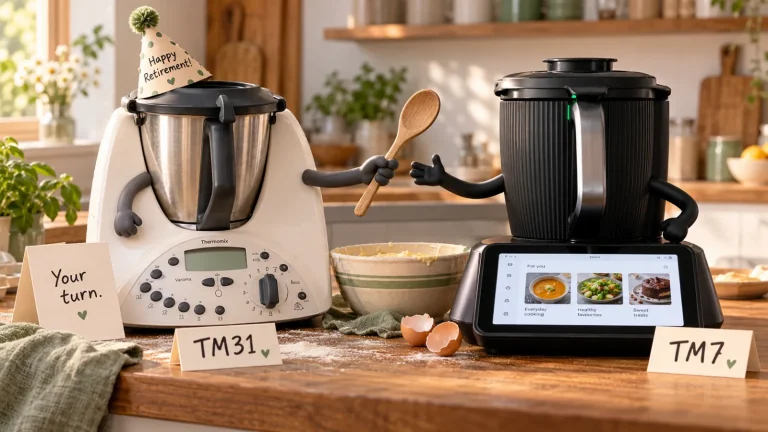
And it was simply fewer steps than getting out the Thermy (my Thermomix) or a full-size blender. Less setting up, less washing up. On a low-spoon morning, that difference is real.
What I wanted this time
A smoothie cup was non-negotiable. I use it A LOT.
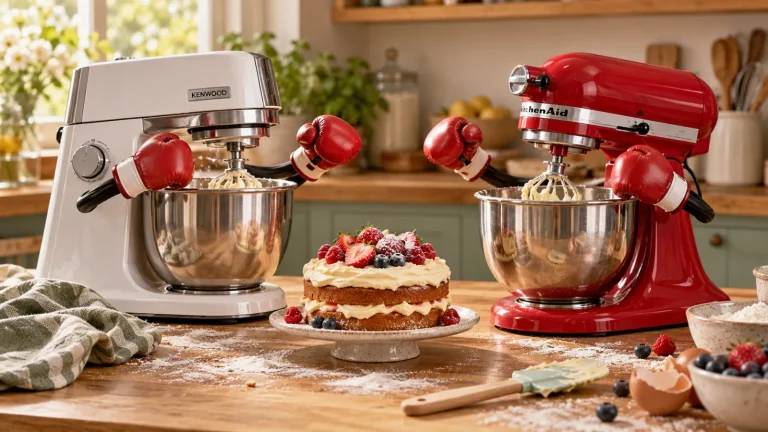
But I also wanted a food processor. I already have a Kenwood Cooking Chef, so I looked hard at buying a processor attachment for it. I’ve compared the cost and effort of that in my Kenwood vs KitchenAid stand mixer guide.
The thing is, I grew up with a Kenwood Chef, and I know attachment life. It’s more fitting, fiddling and stuffing around than I wanted for a quick job. I wanted super easy, and I wanted compact.
What I compared
Kenwood. Being a Kenwood girlie, I started there. I looked at the MultiPro XL Weigh+ Food Processor, the MultiPro Compact Food Processor and Blender and the MultiPro Express Food Processor. All capable machines, but none of them really had the smoothie cup option, and that was the deal-breaker when Ninja had one and was comparable on every other front: size, speed, accessories, weight and price.
Ninja. I compared all of them. And I mean all of them: the personal blenders, the food processors and the all-in-one systems.
The Stealth IQ wasn’t out yet when I bought my Detect. A quieter blender is tempting, especially at 6 am before coffee has happened. But I’m not sure I like quiet enough to pay about $50 more RRP for it.
How I actually use the Ninja Detect
The food processor gets a workout. I use the Hybrid Edge Blade to mix smaller batches of prep bits like meatballs. Bigger batches still go to the Kenwood stand mixer. I grate and shred and chop a significant amount of my food prep in it. I get my money’s worth from that lil guy.
It beats the Thermy for quick jobs. There’s no waiting for it to boot up, there are fewer button presses, and I find it a bit easier to clean. In fairness both go into the dishwasher.
The blender is brilliant for cocktails. It doesn’t heat up and melt the ice as much as the Thermy seems to. Getting the ice right in the Thermy is as much about learning the machine as any flaw in it.
Smoothies still work the way I like. The kit comes with three 700 ml single-serve cups with spout lids, so blend-and-go survives. All on par with my NutriBullet expectations (albeit all new accessories).
Pros and cons
What I like
- One base does the blender jug, smoothie cups and food processor, without the attachment fiddling.
- Ready to go straight away: no boot-up and fewer button presses than the Thermomix for a quick job.
- The food processor and Hybrid Edge Blade get real use for small batches.
- Ice for cocktails stays icier.
- Single-serve cups with lids, so I can still drink from what I blended in.
- I find it a bit easier to clean than the Thermy.
What I don’t
- Accessories are specific to the model, just like NutriBullet’s.
- It does take up more bench space than the NutriBullet, but it’s a completely different machine, so that’s not a fair comparison.
- I had my first one replaced under warranty. Despite saying it was dishwasher safe, the food processor kinda fell apart. Ninja were amazing and it was replaced quickly and without drama – amazing customer service.
Would I buy a NutriBullet again?
100%.
In hindsight, I’d spend the extra $20 to get the 900 W over the 600 W.
Honestly, I don’t think there’s much functional difference between the Ninja and the NutriBullet. The Ninja base my cups sit on now obviously has far more grunt than my 600 W NutriBullet did, but for smoothies, the NutriBullet was awesome.
Hot tip for young players: accessories cost about the same for both brands, and they’re equally annoyingly specific to your exact model. Triple-check yours before you buy extra cups or blades.
Kerry’s pick for smoothies on the road
Kerry is a big Ninja-appliance fan. When she was doing a lot of travel and overnights, she got a Ninja Blast Max Cordless Portable Blender, and she swears by it.
Her reasons are very practical. A smoothie is an easy way to hit her macros, it keeps her satisfied when she isn’t hungry or can’t stop for a proper meal, and it keeps her fluids up.
And I absolutely love a good spoonie smoothie hack.
If you’d rather not buy anything new
- Use what you’ve got. A jug blender or stick blender in the cupboard will make a smoothie. You lose the drink-from-the-cup bit, not the smoothie.
- You don’t need a kitchen system for smoothies alone. A basic personal blender did the job for me for seven years.
- Shop around. These models are sold by the usual appliance retailers too, not just Amazon, so compare prices before you buy.
- Secondhand is fine. Buy Nothing groups and marketplaces often have personal blenders. Check the model number before buying any extra cups or blades.
Want to put a blender to work? Try my Blue Hulk Smoothie or Blueberry Protein Smoothie, and see what else lives in my kitchen in My Low-Spoon Cooking Essentials.