This one isn’t about food, but it’s something people ask me about constantly. My Oska Pulse, a small wearable PEMF device, has become part of how I manage my CRPS. So here’s the whole story of Oska Pulse for CRPS, as I’ve lived it: how I use it, what changed, and what the science does and doesn’t tell us.
Update, 2026
I still use my Oska every single day. I wear it almost constantly through the day, and it usually only needs charging every few days. It sits alongside my regular scrambler therapy top-ups as part of how I manage my CRPS.
Why I tried it
I first wrote this in early 2024. We’d moved house that November, and everything after that was a struggle. I was nearing the end of a treatment cycle from my last scrambler therapy top-up. The stress and extra activity of the move wiped out what was left of my pain baseline. Add a Queensland summer and it was the perfect storm for a flare.
As often happened for me around six months after scrambler, the allodynia was creeping up my leg and into my hip again. (Allodynia is pain from things that shouldn’t hurt, like light touch.) Walking unaided was getting harder.
A girlfriend of mine had just bought an Oska Pulse for her wife, who also lives with CRPS. A bit over a month in, she told me she was glad she’d tried it. We’re on similar treatment plans and tend to react to things the same way, so I figured, what the hell. Worth a try.
What is the Oska Pulse?
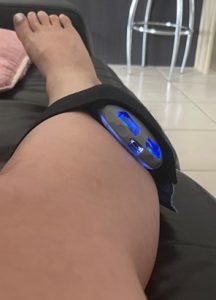
The Oska Pulse is a small, wearable device that uses pulsed electromagnetic field (PEMF) therapy. It’s drug-free and non-invasive. It sits against your body on a soft elastic band.
It’s a very unassuming little thing. It’s lightweight, runs on a rechargeable battery, and almost looks like a kid’s toy when the blue lights are pulsing. The Singaporean calls it my ankle monitor.
I wear mine just above the surgical scar on my right leg, almost all day. When I first started, I’d also slip it under my pillow at night, at the base of my skull. The idea there is to target the vagus nerve, which plays a big part in the body’s “rest and digest” mode. That’s my own experiment, not something I can point to research for.
What changed for me, and how quickly
I started noticing a difference after about a week. The spread into my hip and the burning, stabbing pain in my thigh started to settle. The extreme sensitivity in my foot eased, along with the swelling and stiffness.
In my case, within a month, I was walking around the house without my walker, which was parked in the front room gathering very expensive dust. I could wear slippers again, and I was starting to sleep through the night. If I did wake up, I’d turn Oska back on and doze off again without any fuss.
By the end of January, I could tolerate shoes again, which meant I could wear my brace and manage short trips out without crutches.
A quick note on what I can and can’t claim here. This is what I noticed while using it, at the same time as everything else in my treatment plan. It isn’t proof the device caused it, and it can’t tell you how well it would work for you.
What does it feel like?
Honestly, not much. It doesn’t vibrate or pulse hard. I have the 180-minute model, and at around the 20-minute mark of each cycle I feel 5–10 minutes of subtle but noticeable pulsing. It isn’t painful or unpleasant. I put it on the Singaporean at that exact point in the program, and he couldn’t feel a thing.
The band is soft and adjustable, so I move it up and down my calf and thigh depending on how sensitive my CRPS is that day.
What does the science say?
Over the years I’ve become a lot more particular about researching supplements, medications and treatments, because so much of it just doesn’t work for me. Beyond the money, there’s the emotional rollercoaster. Hope takes a battering every time something fails, and by my fourth year with CRPS, my head had learned to protect my heart from that.
Being a nerd helps, but CRPS research isn’t simple. Here’s my honest read.
- The physics is old; the medical use is newer. PEMF builds on Michael Faraday’s 1830s discovery that a changing magnetic field creates an electrical current. Medical PEMF started gaining ground from the 1970s, and one of its earliest medical uses was for broken bones that weren’t healing.
- For pain, the evidence is mixed. Some studies have looked at PEMF for certain types of pain, particularly osteoarthritis, with mixed results. Many are small and they vary a lot in the devices and settings they use.
- For CRPS specifically, there’s very little. When I spoke to the Australian distributor, they mentioned a clinical study of Oska for CRPS getting under way in Germany. As far as I know, no results have been published yet. Until they are, I’m treating Oska as one useful piece of my own toolkit, not a proven CRPS treatment.
The Oska Pulse is included on the Australian Register of Therapeutic Goods (ARTG), which means it can be legally supplied in Australia as a medical device. That’s worth knowing. But ARTG inclusion isn’t the same as proof that a device works for a particular condition.
Thinking about an Oska Pulse?
For me, yes. Is it a silver bullet? No. But type 2 CRPS is hard to treat, and keeping a stable pain baseline is a constant challenge. For me, Oska helps with that. Alongside everything else, it’s made a noticeable difference to my day-to-day.
If you’re weighing it up:
- Talk to your treating team first, especially if you have an implanted device such as a pacemaker or spinal cord stimulator, or you’re pregnant. Check the manufacturer’s safety information too.
- There are two models, with a 90-minute or 180-minute cycle. I have the 180-minute one. The Australian distributor is based in Perth and covers Australia and New Zealand.
- Insurance and funding vary. My platinum health insurance didn’t cover it. In fairness, it’s been useless for anything CRPS-related that isn’t turning me into a zombie or putting me back in surgery. The Australian site says some customers have used their NDIS plan to cover the cost, so it’s worth asking your plan manager.
You can find out more on the Oska Pulse Australia website.
Pain management has never been one thing for me. It’s diet, movement and the treatments I choose, and Oska has earned its place in that mix. If you’re still mapping out your own options, my CRPS resources page is a good place to start.