Some links on this page are affiliate links. If you buy through one, we may earn a small commission at no cost to you. As an Amazon Associate I earn from qualifying purchases.
I came to Katinka van der Merwe’s work later than most people in the CRPS world. My pain specialist suggested her Hope for Chronic Pain podcast. Not long after, a friend recommended her book, Putting Out the Fire: New Hope for RSD/CRPS.
I liked the podcast enough to read the book. I expected a brochure for the Spero Clinic with a cover on it. It turned out to be more useful than that.
She’s also a Saffa, which made me smile. I grew up with South African family roots, and in my experience that comes with a habit of reaching for holistic and traditional approaches alongside medicine. The Australian default tends to be adding another tablet or cutting something out. I’m not saying either approach is right. I just recognised the instinct.
What Putting Out the Fire covers
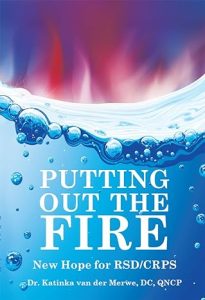 The book came out in 2016. Van der Merwe is a chiropractor who runs the Spero Clinic in Arkansas, so this is a clinician’s book about her clinic’s approach. Read it with that in mind. Listening to her podcast, it’s clear her treatments have kept evolving since the book was published, so a few sections read as a snapshot of where her thinking was at the time.
Here’s what she walks through:
- What CRPS actually is, including symptoms many of us wouldn’t think to connect to it
- How the nervous system responds to long-term pain, explained in plain English rather than textbook-speak
- The vagus nerve and the autonomic nervous system, and why vagal tone matters
- Cellular inflammation, framed functionally
- Treatment modalities, with a heavy emphasis on diet, including the ketogenic diet and common trigger ingredients for people with CRPS
- Supplementation, which gets its own chapter
What I actually took from it
The theme I keep running into, whether I’m reading research or talking to my care team, is that nothing works on its own. The approaches that help with CRPS are multi-modal and support each other. There’s no silver bullet, and that includes the Spero Clinic.
The nervous system chapters were the most valuable part for me. Once I understood why my body reacts the way it does to long-term pain, I could get ahead of my pain instead of only reacting to it. Understanding the mechanism changed what I did day to day.
The diet chapters were interesting to me as a nutrition nerd. She makes a case for keto as part of pain management. The evidence on keto for CRPS specifically is promising rather than settled. There’s a plausible mechanism, but a plausible mechanism isn’t the same as proof. Keto happens to be how I eat anyway, so this was less of a leap for me than it might be for someone else. I’ve gone deeper on this in why keto may help with pain management.
The supplement chapter is where I made actual changes. I refined my supplements based on it and noticed marginal improvements. The honest version is that I mostly notice when I don’t take them, rather than feeling dramatically better when I do. If that makes sense, you’ve probably been there.
What works for me won’t automatically suit you. Talk any supplement or diet changes through with your own care team, especially if you’re on other medications.
About the Spero Clinic
The Spero Clinic has built a reputation for non-invasive nervous system rehabilitation, and it reports a number of patients going into remission. It’s also where a lot of spoonies get uneasy, for three reasons:
- The cost. The full program is a lot of money, before you count flights from Australia.
- The marketing. It’s polished in a way that sets off some people’s alarm bells.
- Access. Parts of the approach are proprietary, which frustrates people who want treatments to be more widely available.
I understand all three. Here’s what I’ve worked out from the book and the podcast: a fair few of the treatments she discusses are available in Australia, though not under one roof. And there’s plenty you can do yourself or with your local care team. I’ve pulled together the CRPS resources and approaches I’ve found most helpful if you want the practical version.
Other books by Katinka van der Merwe
She has also written:
- Taming the Beast: A Guide to Conquering Fibromyalgia (2013)
- A Paradigm Shift in Treating EDS/POTS (2024)
I haven’t read either. From what I can tell, they follow the same holistic philosophy as her clinic.
Spoonie brain hack: getting books back with text-to-speech
Since CRPS, reading for fun has become hard work. Plenty of books also aren’t available on Audible in Australia, which is deeply annoying. I wasn’t willing to let CRPS take another thing I love, so I started trying text-to-speech apps.
After testing a few, I landed on the premium subscription for Speechify (affiliate link). I use it on my desktop and phone for study textbooks and Kindle books that aren’t on Audible.
The trick that makes it work for my brain is the voices. Right now, Snoop Dogg is reading me my nutrition studies, and anatomy has never been so entertaining. I use different voices for different genres. That helps my brain separate “study, pay attention” from “recreation, wind down.” There’s some science behind this. Mostly, though, it just works for me.
Is Putting Out the Fire worth reading?
If you have CRPS and want to understand what your nervous system is doing, yes. It’s one of the more readable explanations I’ve come across. Treat it as a well-informed starting point rather than a treatment plan. And if reading is a spoon you don’t have today, put it in a text-to-speech app and let someone else do the reading.