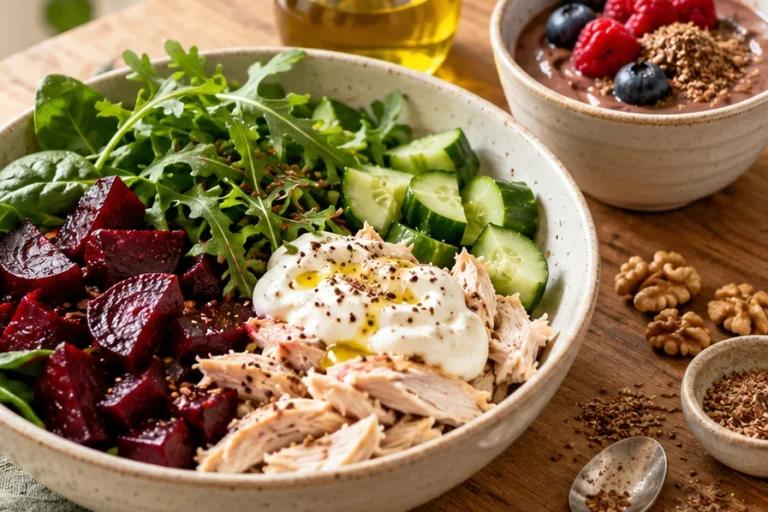
Spend five minutes in any keto or low-carb corner of the internet and someone will ask about your macros. So, what are macros? It’s short for macronutrients: protein, carbohydrate and fat. They’re the nutrients we eat in large amounts and get our energy from. Vitamins and minerals are the micronutrients. We need them too, just in much smaller amounts.
I like macros as a topic because the basics are genuinely settled science. What’s far less settled is exactly how much of each you need, and that’s where the internet gets loud. So this guide covers the solid stuff first, then what the Australian guidelines say, and then where keto fits in.
And no, you don’t need to weigh every gram to use any of it.
What are macros, in practice?
Most foods contain a mix of all three macronutrients. Usually one does most of the work.
Take a banana. Roughly 90% of its energy comes from carbohydrate, with a little protein and a trace of fat. An avocado goes the other way: around three-quarters or more of its energy comes from fat, with small amounts of carbohydrate and protein. So a banana is “a carb” and an avocado is “a fat”, even though neither is only one thing.
Each macro gives you a different amount of energy per gram. Australian labels show energy in kilojoules (kJ), so here are both units:
| Per gram | Kilojoules | Calories |
|---|---|---|
| Protein | 17 kJ | 4 kcal |
| Carbohydrate | 17 kJ | 4 kcal |
| Fat | 37 kJ | 9 kcal |
| Dietary fibre | 8 kJ | about 2 kcal |
(Alcohol also provides energy, at 29 kJ per gram, but nobody’s calling it a nutrient.)
For a deeper look at what the body actually does with each one, read how macros fuel our body.
Protein

Protein is the building and repair crew. It’s made from amino acids, and there are 20 of them in the food we eat. Nine are essential, meaning your body can’t make them, so they have to come from food.
- What it does: builds and repairs muscle and other tissue, and makes enzymes, some hormones and immune cells.
- Complete vs incomplete: a “complete” protein contains all nine essential amino acids. Meat, fish, eggs, dairy and soy are complete. Most other plant proteins are lower in one or two essential amino acids. Eating a mix across the day covers the gaps, so they don’t all have to be on the same plate.
- Is a high-protein diet safe? In healthy adults, higher protein intakes haven’t been shown to cause harm. If you have kidney disease, get individual advice before upping your protein.
How much protein?
This is where I get nerdy. Australia’s recommended dietary intake (RDI) for adults aged 19–70 is about 0.84 g per kg of body weight a day for men and 0.75 g/kg for women. Over 70, that rises to about 1 g/kg.
You’ll often see 0.6–0.8 g per pound quoted online, and this post used to quote it too. That’s roughly 1.3–1.8 g per kilo, or about double the RDI. That range is common in sports nutrition, and neither figure is wrong. They just answer different questions. An RDI is set to cover the needs of nearly everyone in the population. It isn’t a target for what’s ideal for you. Older adults, active people and anyone recovering from illness or injury are often advised to eat more than the RDI. A dietitian can help you work out your own number.
Low-spoon protein: eggs, tinned tuna or salmon, supermarket roast chicken, Greek yoghurt, cottage cheese, frozen edamame, or a protein smoothie. None of these needs a knife.
Carbohydrates

Carbohydrates are sugars, starches and fibre. Your body breaks the sugars and starches down into simple sugars, mostly glucose. Glucose is the default fuel for your brain and muscles.
- Not strictly essential. Your body can make the glucose it needs from protein and fat, and it can run largely on ketones instead. That’s the whole basis of a ketogenic diet.
- Exercise is the catch. High-intensity exercise tends to rely on carbohydrate, and some studies find performance at the top end drops on very low-carb diets. For everyday movement, it matters much less.
- Simple vs complex. Simple carbs (sugars) are absorbed quickly. Complex carbs (starches in grains, legumes and starchy veg) need breaking down first. The glycaemic index (GI) ranks foods by how quickly they raise blood glucose. Fibre, fat and protein in the same meal all slow that down.
- Fibre is the carbohydrate you mostly don’t digest. It feeds your gut bacteria and helps keep things moving.
A handy Australian label fact: on Australian and New Zealand nutrition panels, the “Carbohydrate” figure already excludes dietary fibre, which is listed separately. So there’s no need to subtract fibre to get “net carbs” the way you would with a US label. Read the number as it is.
The guidelines: Australia’s healthy range for adults is 45–65% of energy from carbohydrate. Athletes are often advised 3–12 g per kg of body weight a day, depending on their training load. Keto and low-carb eating sit well below that range, and that’s deliberate. If you’re weighing up the two, start with keto vs low carb: what’s the difference?
Fat

Most of the fat we eat is in the form of triglycerides: three fatty acids attached to a glycerol backbone. Fat is the most energy-dense macro, at more than double the energy per gram of protein or carbs. It’s also slower for the body to access than glucose.
- What it does: forms part of every cell membrane, helps make hormones, and lets you absorb the fat-soluble vitamins A, D, E and K.
- Essential fats: two fatty acids have to come from food: an omega-3 (alpha-linolenic acid) and an omega-6 (linoleic acid). Your body can make omega-9s itself.
- Saturated fat is mostly solid at room temperature. You’ll find it in butter, cheese, fatty meat, coconut, chocolate and many baked goods.
- Monounsaturated fat is found in olive oil, avocado and many nuts.
- Polyunsaturated fat is found in oily fish, walnuts, and seeds like chia and linseed. This is where most of your omega-3s and omega-6s come from.
- Trans fat mostly comes from partially hydrogenated oils. In 2015, the US FDA ruled that these oils were no longer “generally recognised as safe” and gave manufacturers three years to remove them. Australia hasn’t banned trans fats. Food Standards Australia New Zealand (FSANZ) reports that Australians get around 0.5% of their energy from them, which is below the World Health Organization’s 1% limit.
The guidelines: Australia’s healthy range for adults is 20–35% of energy from fat, with saturated and trans fats together kept to no more than about 8–10%.
Keto goes well past 35% fat, by design. I’m not going to pretend otherwise. It’s a choice some of us make for good reasons, and it’s worth making with your eyes open, ideally with your GP or a dietitian in the loop.
How we work out the macros in our recipes
We usually use Carb Manager to calculate the macros. The numbers are based on the specific brands we tested with, so a different brand can give you slightly different figures.
Carb Manager is an American app. Its database lets users add their own products and share them with everyone else. That’s handy, but an entry is only as accurate as whoever added it.
American labels include fibre in the total carbohydrate count, so you need to subtract it yourself to get net carbs. If you’re checking an American product, do that sum first. On an Australian label, the carbohydrate figure already excludes fibre, so the number on the panel is your net carbs (see the Australian label fact above).
When a result looks really weird, we check it against CalorieKing and build our own ingredient entry in Carb Manager.
Either way, macros aren’t an exact science. Find brands that suit your macros and your budget, and let the Yuka app scan the labels so you don’t have to squint at them. You can read more about how we create and test recipes.
Macros on a low-spoon day
- You don’t have to track anything. “Is there some protein on this plate?” gets you most of the way.
- If you like numbers, our keto macro calculator, low-carb macro calculator and Australian Dietary Guidelines macro calculator do the maths for you.
- Compare labels per 100 g, not per serve. Serving sizes are whatever the manufacturer felt like that day. There’s more on this in our low energy grocery shopping guide.
- Scan instead of squinting. I use the Yuka app to scan barcodes and check the carbs per 100 g, which beats standing in the aisle reading 6-point font. Just know its score isn’t built for keto, so butter and cheese get marked down. Here’s how I use Yuka for keto and low-carb shopping.
- Shortcuts count. A roast chicken and a bag of salad leaves give you a perfectly good mix of macros with zero chopping.
The upshot
So, what are macros, really? Protein builds and repairs, carbohydrate is the body’s default fuel, and fat keeps your cells, hormones and vitamin absorption working. All three earn their place.
How you balance them depends on your body, your goals and how you choose to eat. That might be the Australian guidelines, low carb or keto. Understanding what each macro actually does makes it a lot easier to make that choice deliberately, instead of because a forum told you to.
Sources: NHMRC Nutrient Reference Values: macronutrient balance · FSANZ: trans fats · Food Standards Code, Schedule 11 (energy factors and carbohydrate)