This is an independent review. I bought these myself. You can read how we choose products in our editorial, health and sourcing policy.
I have a complicated relationship with supplements.
On one hand, I’d much rather get what I need from food. On the other hand, pain suppresses my appetite, and my ASD brain is perfectly capable of forgetting lunch exists. Unfortunately, my body’s nutritional requirements don’t disappear just because eating has temporarily become optional. There are plenty of days I don’t hit my macros, even when what I do eat is good food.
That’s the gap supplements are supposed to fill. The problem is that the supplement aisle is mostly marketing, proprietary blends and ingredient lists that need a chemistry degree to decode.
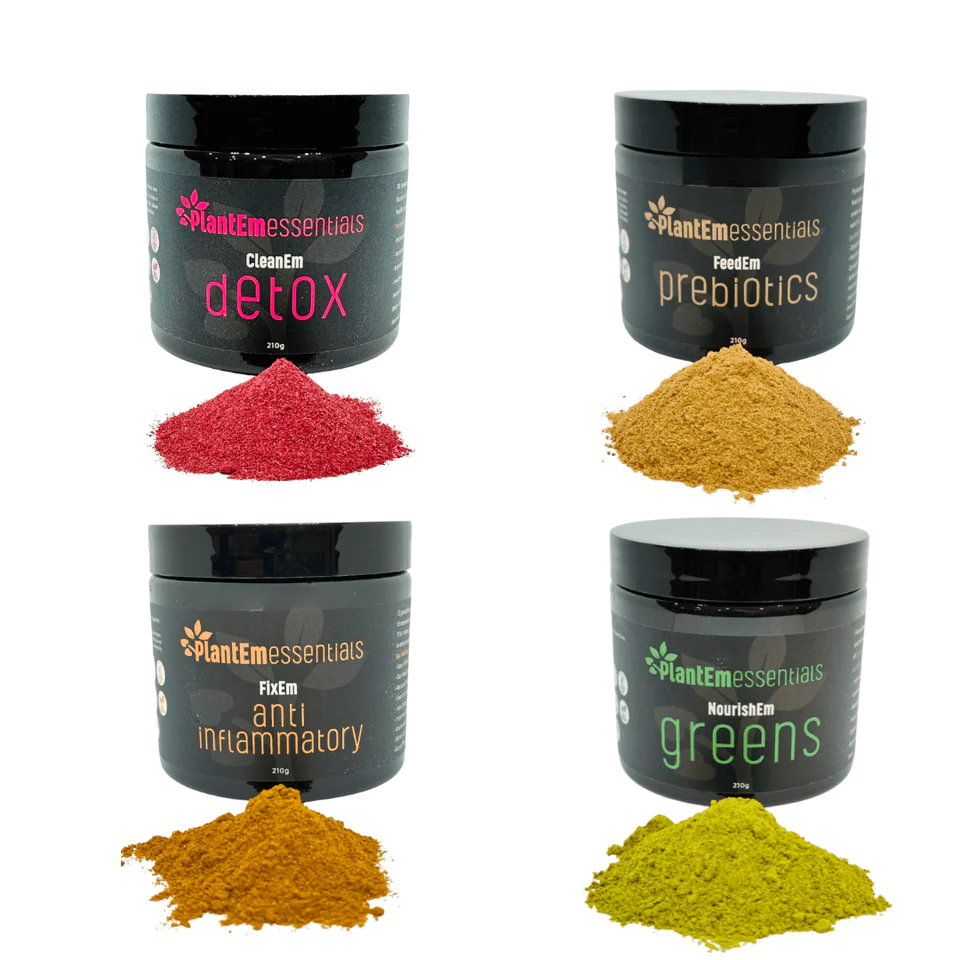
A friend of Kerry’s put us onto Dr Kez, a Melbourne chiropractor who is very funny and very generous with what she shares online. Her PlantEm Essentials range caught my attention for a fairly simple reason: I could read the ingredient list and recognise everything on it.
What’s actually in them
These are powdered whole foods, not extracts. They’re Australian made and owned, with no fillers, flavours or artificial sweeteners. Two of them do contain stevia leaf, which is worth knowing if you avoid it.
There are four in the range. Some have been renamed since I first bought them, so here are both names:
| Product | Previously called | What’s in it | Serves per tub |
|---|---|---|---|
| Greens | NourishEm Greens | Spinach, moringa, broccoli sprout, kale, papaya, coconut, stevia leaf, lemon peel, red capsicum, barley grass, barberry bark, parsley, alfalfa sprouts, wheatgrass | 35 |
| Turmeric Blend | FixEm | Turmeric, Ceylon cinnamon, stevia leaf, coconut, black pepper, orange peel, ginger, rosemary, aniseed, clove, chicory root, cardamom, fennel seed | 52 |
| Daily Beetroot Blend | CleanEm | Beetroot, apple, carrot, lemon peel, orange peel, chicory root, galangal, ginger, milk thistle, rice | 35 |
| Prebiotics | FeedEm | Chicory root, green banana flour, Ceylon cinnamon, cardamom, cacao, aniseed, fennel seed, orange peel, ginger | 105 |
What the evidence says (and doesn’t)
This is where I put my nutrition-nerd hat on, because “whole food” is a nice phrase that can hide a lot.
Greens. One scoop is about 6g, and the label says that’s roughly equal to a cup of leafy greens. By dry weight, that’s plausible. Leafy greens are mostly water, so a cup of fresh spinach dries down to only a few grams. What you don’t get is the volume, the chewing and the fullness of an actual salad. I think of it as a top-up on days when vegetables aren’t happening, not a replacement.
Turmeric Blend. This is the one where I had to be honest with myself. Most of the turmeric research uses curcumin extracts, often at hundreds of milligrams to a couple of grams a day. Turmeric root is only around 3% curcumin. A 4g scoop of a 13-ingredient blend contains some turmeric, but nowhere near a study dose. The black pepper helps, because piperine improves curcumin absorption. Even so, I take this because it’s a pleasant, warming drink made from spices with a long history in food. I don’t take it because I think one scoop is doing what the studies did.
Beetroot Blend. Beetroot contains dietary nitrates, which the body converts to nitric oxide. There’s reasonable evidence that nitrates can modestly lower blood pressure and help exercise performance, although the studies tend to use concentrated beetroot juice. It used to be called a “detox” powder. I’m glad that’s gone. Your liver and kidneys do the detoxing, and they don’t need a powder to do it.
Prebiotics. This is the one with the most solid reasoning behind it. Chicory root is a rich source of inulin, and green banana flour is high in resistant starch. Both are fibres that feed the bacteria in your gut, and there’s good evidence for that. It’s also why the instructions say to start with half a scoop for a few weeks. Too much fermentable fibre too fast can mean bloating and wind. If you follow a low FODMAP diet for IBS, inulin is a fructan, so this one may not suit you. I’ve written more about the gut in the gut-brain axis: what the science actually says.
One more thing. You’ll often see whole-food powders described as “more bioavailable” than synthetic vitamins. That’s not true across the board. It depends on the nutrient. Some synthetic forms are absorbed just as well as food forms, and one or two are absorbed better. The real advantage of whole-food powders is everything else that comes along with the vitamins: fibre, polyphenols and the rest of the plant.
What I noticed
After about six weeks of taking them, I felt a bit less creaky, my head was a bit clearer, and my energy was more even. That included days when I hadn’t hit my macros.
That’s my experience, not a clinical trial. I can’t separate the powders from everything else that changed in those weeks, and I’d be suspicious of anyone who told you they could. What I can say is that they made it easier to get something nutritious into me on the days when eating was hard. On low-spoon days, that counts for a lot.
What about the carbs?
They’re whole foods, so they do have carbs. When I checked, the figures were:
- Greens: about 1.5g carbs per serve
- Turmeric Blend: about 1.6g carbs per serve
- Beetroot Blend: about 4.7g carbs per serve. Most of this comes from the beetroot, carrot, apple and rice.
If you’re tracking closely, count them. Personally, I don’t bother. A few grams of carbs from whole vegetables and fruit, with no added sugar, is a trade I’m happy to make for what comes with them. Are all the ingredients technically keto? No. Does that bother me here? Also no. If you’re still working out your own numbers, macros made simple is a good place to start.
What do they taste like?
That depends who you ask.
The Turmeric Blend smells a bit like gingerbread, thanks to the cloves and cinnamon. I’m not convinced it tastes like gingerbread, but it’s pleasant. I like all of them in plain water first thing in the morning. If you’d rather hide the taste, they work in yoghurt or a smoothie. A Blueberry Protein Smoothie or our Green and Clean Smoothie masks them well.
The trick that actually made them stick for me was attaching them to something I already do every day. If I’m making my morning drink anyway, the scoop goes in. If it has to be its own separate task, I forget. That’s not a willpower problem. It’s how executive function works when you’re running low on spoons.
Dr Kez’s partner mixes them into a thick protein paste that looks a bit like pudding. Each to their own.
Here’s how they work
https://www.facebook.com/drkezchirolab/videos/879945540384812/[Re-embed the Dr Kez Facebook video here using an Embed block: ]
Before you start
“Whole food” doesn’t mean “no interactions”. Turmeric can interact with blood thinners and some other medications. Milk thistle, which is in the Beetroot Blend, can affect how some medicines are processed. If you’re on regular medication, and most of us are, have a quick chat with your GP or pharmacist first.
How much, and where to get them
You can buy them at Dr Kez’s clinic in Melbourne or through her online shop. Each tub is $67.95 RRP, although they’re often on sale. The Revive and Thrive Kit gets you all four for $231.80. Shipping is free on orders over $150, and Afterpay is available.
Because the serves per tub vary so much, I worked out the cost per serve at full price:
| Product | Serves | Cost per serve (RRP) |
|---|---|---|
| Prebiotics | 105 | about $0.65 |
| Turmeric Blend | 52 | about $1.31 |
| Greens | 35 | about $1.94 |
| Beetroot Blend | 35 | about $1.94 |
Taking all four daily works out to roughly $5.80 a day, or around $40 a week. That’s not nothing. If the budget only stretches to one, I’d start with whichever fills your biggest gap. For me, that’s the Greens on days when vegetables aren’t happening.
If you’re working out what’s worth the spoons (and the money), I’ve written about why convenience ingredients are accessibility tools. You’ll also find more on how I eat to manage pain in why keto helps with pain management.